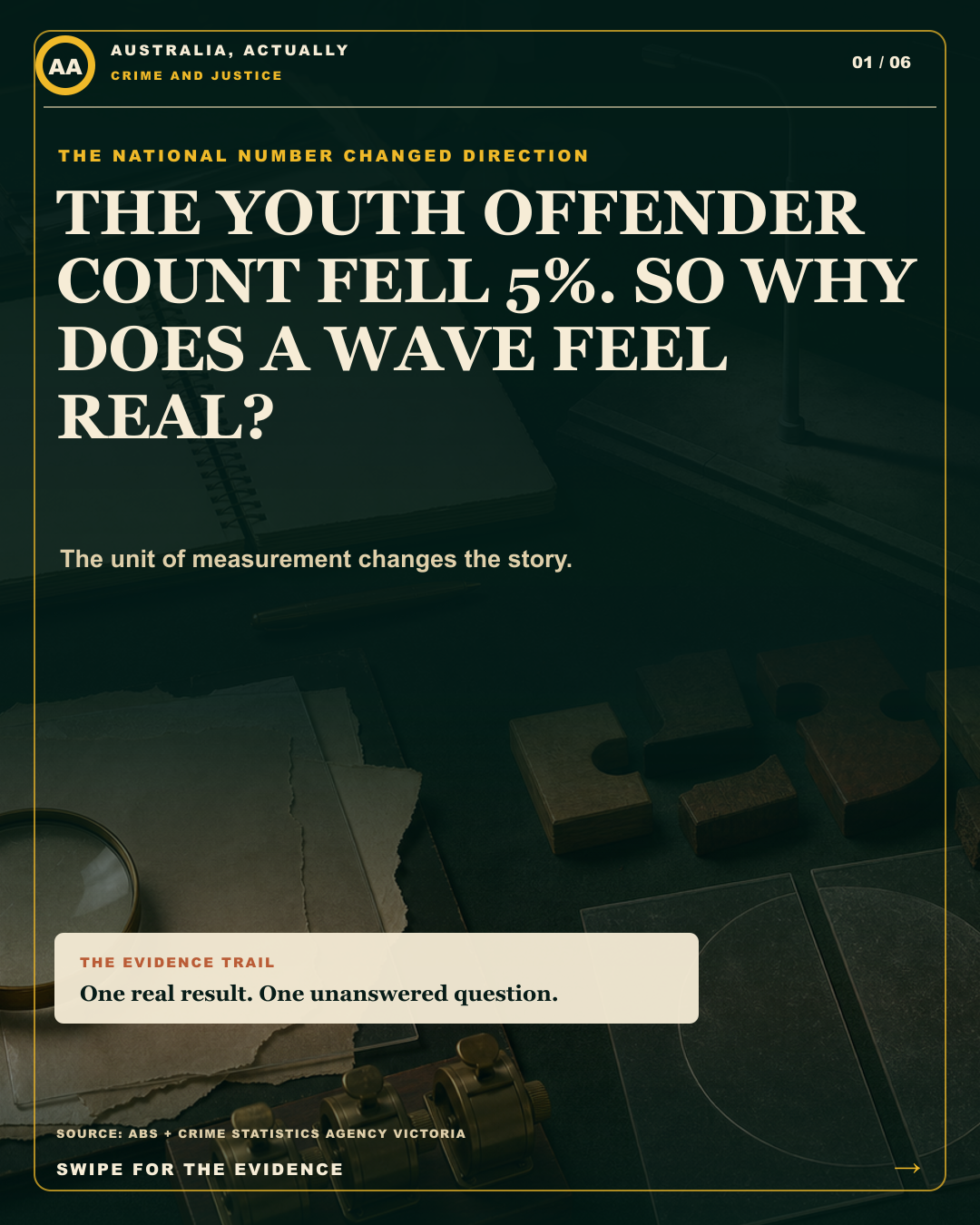
Youth crime is not one number. A person count, incident count, victim count and offence rate can move in different directions, especially across states and short periods.
The latest national people count went down
The Australian Bureau of Statistics recorded 44,583 alleged offenders aged 10 to 17 who were proceeded against by police in 2024-25. That was 2,215 fewer people than in 2023-24, a fall of 5 per cent.
After accounting for population, the youth alleged-offender rate was 1,950 per 100,000 people aged 10 to 17. The rate remained higher than the total offender rate, so the fall does not mean youth offending is trivial. It means the latest national series is moving down, not up.
People are not incidents
One alleged offender can be linked to more than one incident. One incident can include more than one alleged offender. A small group of repeat alleged offenders can therefore push incident counts up without an equal rise in the number of separate young people proceeded against.
Victim data answer another question again. A fall in the number of alleged offenders does not guarantee fewer victims of every offence. The national ABS result cannot be used to wave away a burglary, assault or vehicle theft pattern in a specific community.
Place and period can reverse the headline
Crime is geographically concentrated and state systems differ. Victoria's Crime Statistics Agency reported in June 2026 that youth offending decreased in the year to 31 March 2026 while adult offending increased. Yet earlier Victorian releases recorded strong increases in offences and youth-related incidents over other periods.
Those statements are not automatically contradictory. A series can surge, reach a high level and then fall in the next comparison. A statewide total can fall while selected offences or suburbs rise. Choosing one start date without showing the longer series can manufacture either panic or reassurance.
Recorded crime is shaped by recording
Police activity, reporting behaviour, legal definitions and data systems affect recorded-crime statistics. The ABS methodology warns users to consider differences across states and territories. That does not make the data useless. It sets the boundary on what can be compared.
Why public fear can rise while a broad count falls
Rare but serious incidents can dominate attention. Video footage makes one event visible nationwide. Repeat offending can impose concentrated harm on victims, retail workers and neighbourhoods. People do not experience a national average; they experience what happens near them.
Policy still needs a denominator. A government deciding where to place police, prevention, courts or youth services must know whether the change is in unique people, repeat incidents, severity, location or reporting. A slogan cannot allocate a service.
A local crisis can be real while a national wave is the wrong description.
The conclusion
Australia's latest national youth alleged-offender count does not show a broad surge. It fell 5 per cent in 2024-25. That is strong evidence against an unqualified claim that youth offending is rising everywhere.
It is not evidence that every community is safer or every serious offence is down. The accurate answer must name the offence, place, measure and period. Once those four labels are visible, the argument becomes harder to weaponise and more useful to victims and policy.
- Australian Bureau of Statistics: Recorded Crime - Offenders, 2024-25, National youth alleged-offender count, change and rate.
- Australian Bureau of Statistics: Recorded Crime - Offenders methodology, Definitions, police-proceeding boundary and comparability limits.
- Crime Statistics Agency Victoria: Adult offending increases as youth offending decreases, Current Victorian direction for the year to March 2026.
- Crime Statistics Agency Victoria: Youth crime research, State research and fact sheets on youth-offending measures.
Sources checked 2 August 2026. Alleged offenders, incidents, offences, victims and convictions are not interchangeable. State and national series use different periods and definitions. Found a problem? See our correction process.