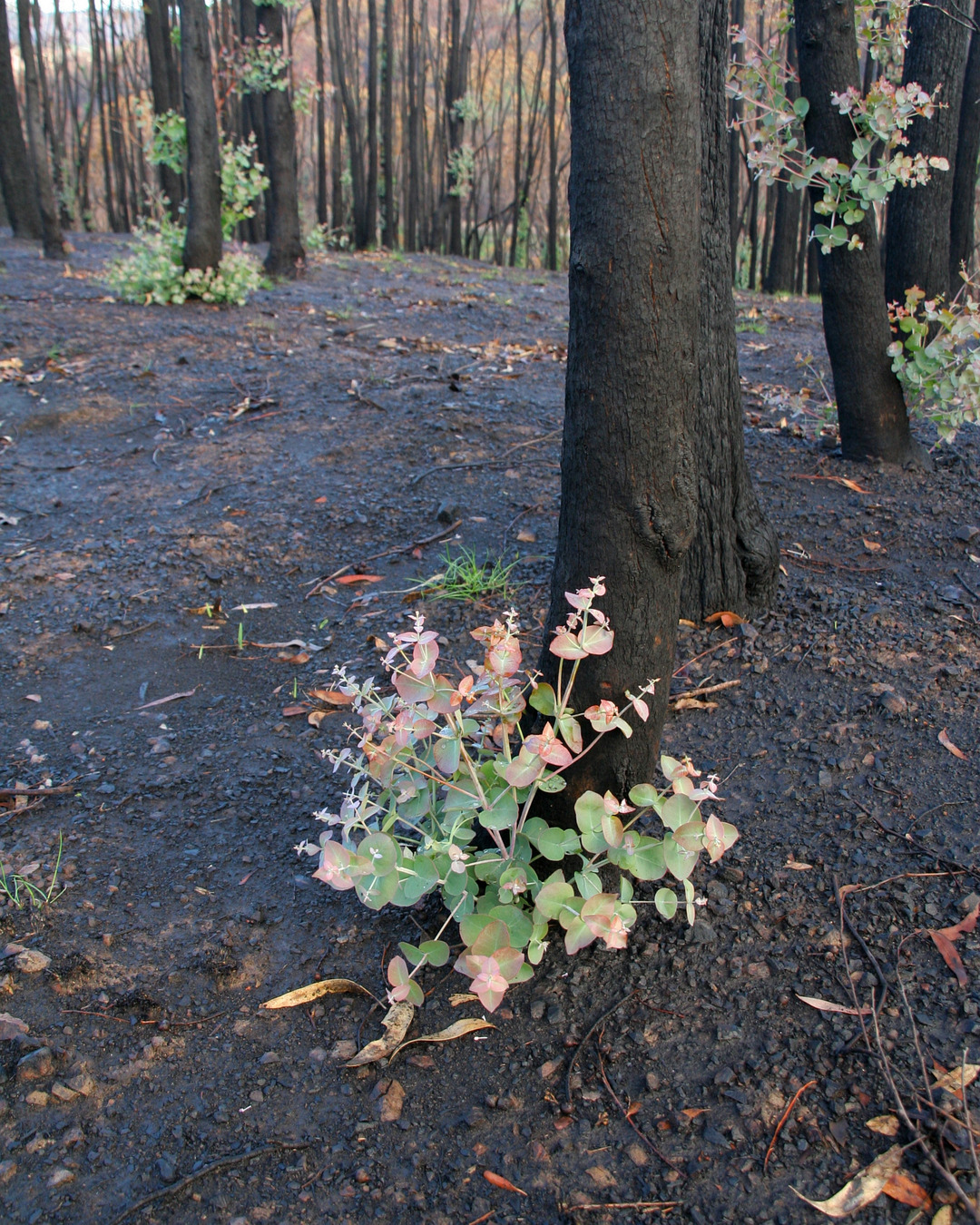
A blackened trunk can sprout again. Another eucalypt may need a new generation from seed.
The leaves on a burnt trunk have a name
After a bushfire, green leaves can emerge directly from a blackened eucalypt trunk. CSIRO explains that many species regenerate through epicormic shoots from buds protected under bark. Others regenerate from lignotubers, swollen structures at the base of a plant that can hold buds and resources. These mechanisms make a dramatic recovery visible, but they do not make every eucalypt equivalent or guarantee that an individual tree will survive.
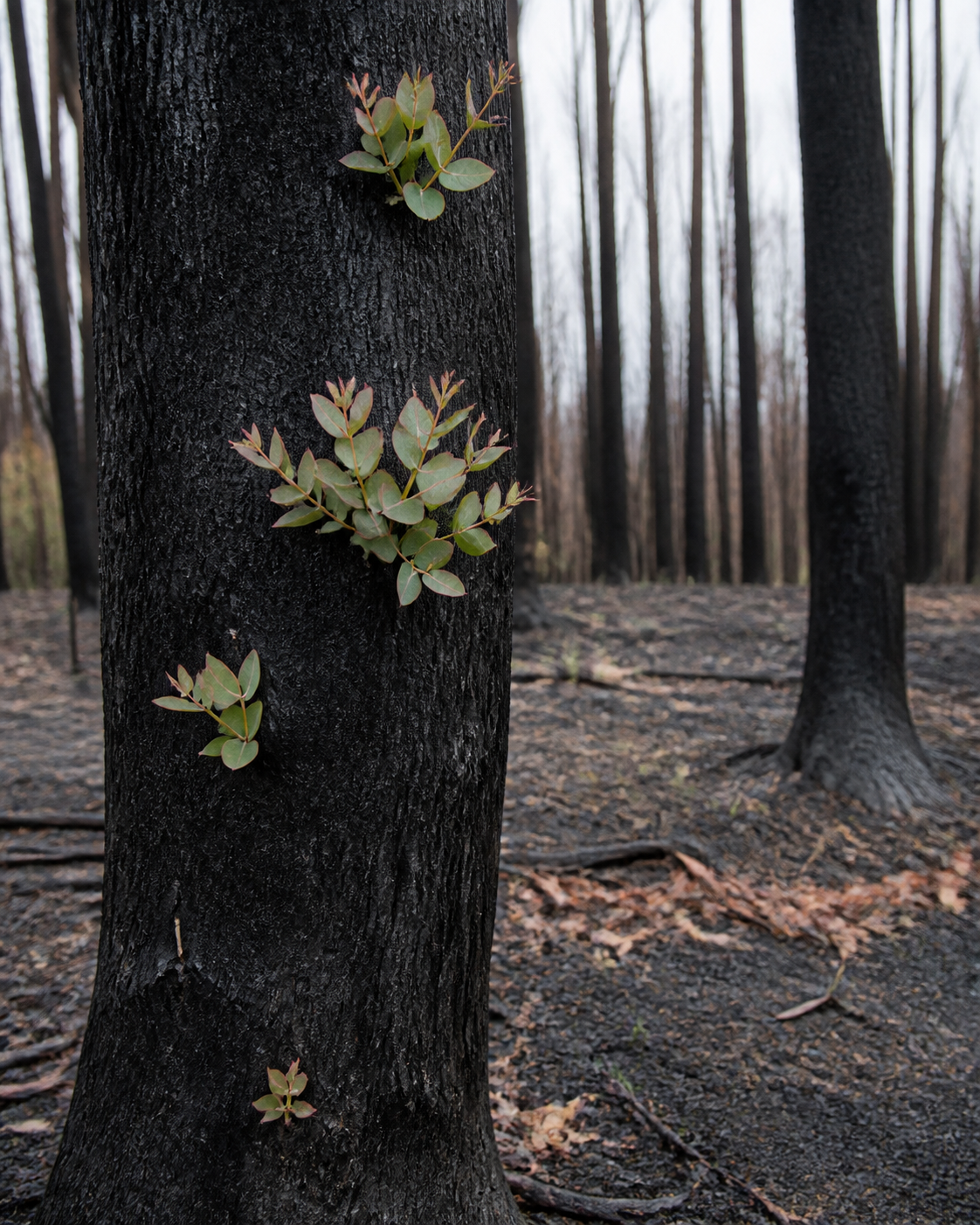
Protection changes the path after fire
Bark can help protect dormant buds from heat. A lignotuber can support regrowth from near ground level. In species that use these strategies, an adult may survive and resprout after a fire. That differs from a species whose adult trees are more likely to be killed and whose next generation depends on seed. The important distinction is not whether one path is better in the abstract. It is which structures survive a particular fire and whether the next stage of recovery can establish.
Mountain Ash is a useful contrast
CSIRO identifies Mountain Ash as an example of a eucalypt that can be easily destroyed by fire because of its thin bark. It describes heat triggering seeds to begin growing, taking advantage of a newly opened forest. This package uses Mountain Ash as a contrast, not as a shortcut for all ash or all eucalypts. It does not use a universal maturity period because timing varies with species and the conditions needed for a seed crop to contribute to future recovery.
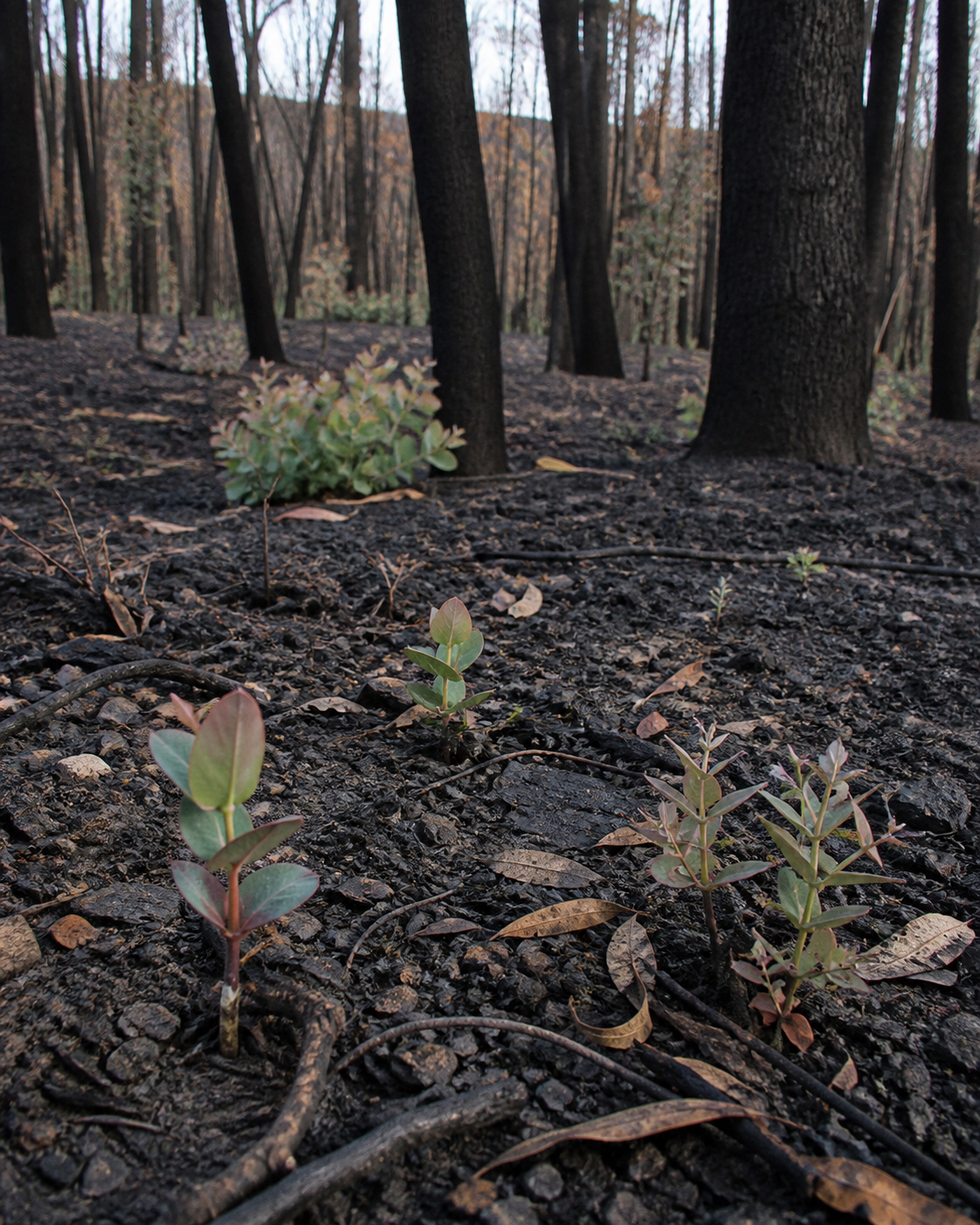
Severity and repeat fire still matter
A fire can be hot enough to damage the buds or structures a resprouting species needs. A seed-reliant forest can also be vulnerable if another severe fire arrives before new trees have produced enough seed. Research routes reviewed for this commission show that fire severity and eucalypt responses are species-specific. That is why a general photo of post-fire green growth cannot demonstrate recovery for a different forest, and why this article uses a labelled diagram rather than a dramatic bushfire image as evidence.
'Eucalypts need fire' is too blunt. The better question is which species, which structure and which fire.
The public value is a more precise way of seeing a familiar scene. Epicormic buds and lignotubers explain why some trees can resprout. Thin bark and seed-based replacement explain why another eucalypt may follow a different route. The article cannot diagnose a tree, predict a forest's recovery or provide bushfire-safety advice. For any current fire or property decision, official emergency and land-management information is the appropriate source.
- CSIRO: Bushfire impact on Australian plants, January 2020. Lignotubers, epicormic shoots, Mountain Ash thin bark and heat-triggered seed context.
- Parks Victoria: Plants in fire affected areas lead recovery, 13 February 2020. Public land-management context for plant recovery and species differences.
- Australian National University research portal: Influence of fire severity on the regeneration, recruitment and distribution of eucalypts in the Cotter River Catchment, February 2008. Peer-reviewed species-specific fire-severity study route.
- Photograph: Robert Kerton / CSIRO, Eucalypt regrowth after Black Saturday bushfires, Strathewen, Victoria, four months after the 2009 Black Saturday bushfires. CC BY 3.0; cropped for the article cover.
CSIRO, Parks Victoria and the Australian National University research portal were rechecked and reachable on 10 August 2026; recheck current sources at the next ordinary review. Found a problem? See our correction process.