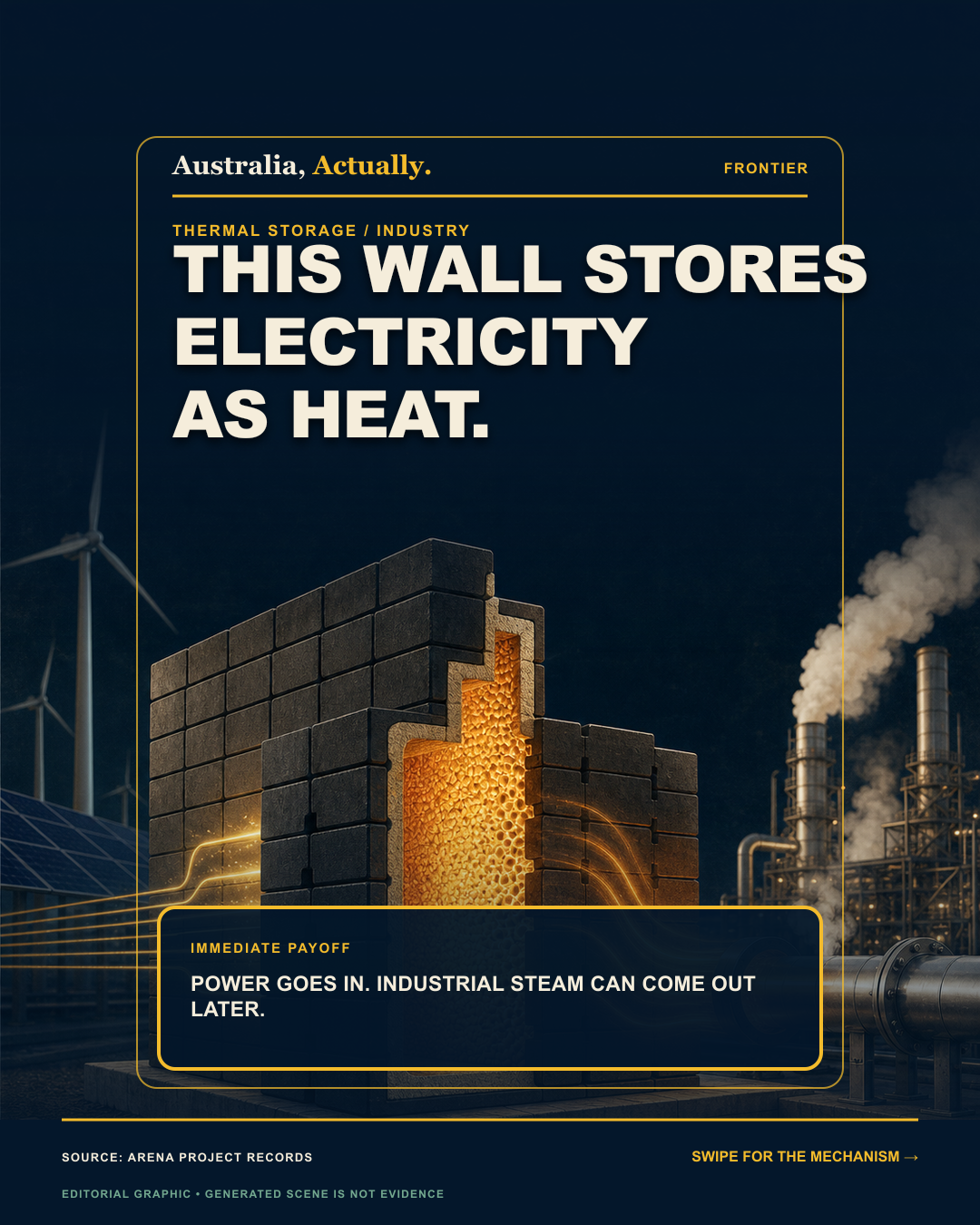
Electricity can be converted into heat, held in a phase-change material and returned later as hot air or steam. The difficult questions are scale, losses, integration and cost.
Charge the store with heat
Surplus or low-cost electricity can run resistive heaters or another heat source. Hot air then transfers that energy into a stack of MGA blocks. Each block contains metal particles held within a higher-temperature matrix. When the particles reach their melting point, they absorb latent heat while the block keeps its external shape. The stack can therefore hold more energy across a narrow temperature range than ordinary sensible heating alone.
Discharge it into an industrial process
When heat is needed, cooler air passes through the store and collects energy as the internal particles solidify. A heat exchanger can use the hot air to raise steam or serve another thermal load. This is why the technology is often described as a heat battery. The label is intuitive, but the device is not an electrochemical battery and does not automatically return electricity.
The demonstration established a real scale
ARENA lists the MGA Thermal Energy Storage Project as completed in October 2025. The demonstration system was rated at 0.5 megawatts thermal and 5 megawatt-hours thermal. Those figures describe heat power and heat capacity. The project produced operational learning about block manufacture, charging, discharging, controls and integration. It did not settle the cost and reliability of every larger proposed installation.
Deployment depends on the heat customer
A useful project needs a source of electricity, a temperature matched to the industrial process, enough cycling, acceptable heat losses and a customer able to use the output. ARENA-supported studies and the Kwinana deployment project examine larger configurations and particular sites. Their designs should not be silently folded into the completed demonstration as if all stages were already operating.
The wall stores energy by hiding a melt-and-freeze cycle inside blocks that stay solid.
The mechanism earns attention because it is concrete: electricity in, phase change inside, industrial heat out later. The commercial question remains site specific. Capacity, temperature, efficiency, lifetime, cost and the value of displaced fuel must all be measured at the scale and duty cycle a customer actually needs.
- ARENA: MGA Thermal Energy Storage Project, Official completed-project record including the 0.5 MWth and 5 MWhth demonstration scale.
- ARENA: MGA Thermal final knowledge-sharing report, Primary project report on the block mechanism, system operation and lessons.
- ARENA: Knode Kwinana thermal-storage deployment, Current separate deployment project, used to distinguish future scale from the completed demonstration.
ARENA project pages and the October 2025 final report checked 3 August 2026. Completed demonstration, studies and proposed deployments are kept separate. Found a problem? See our correction process.