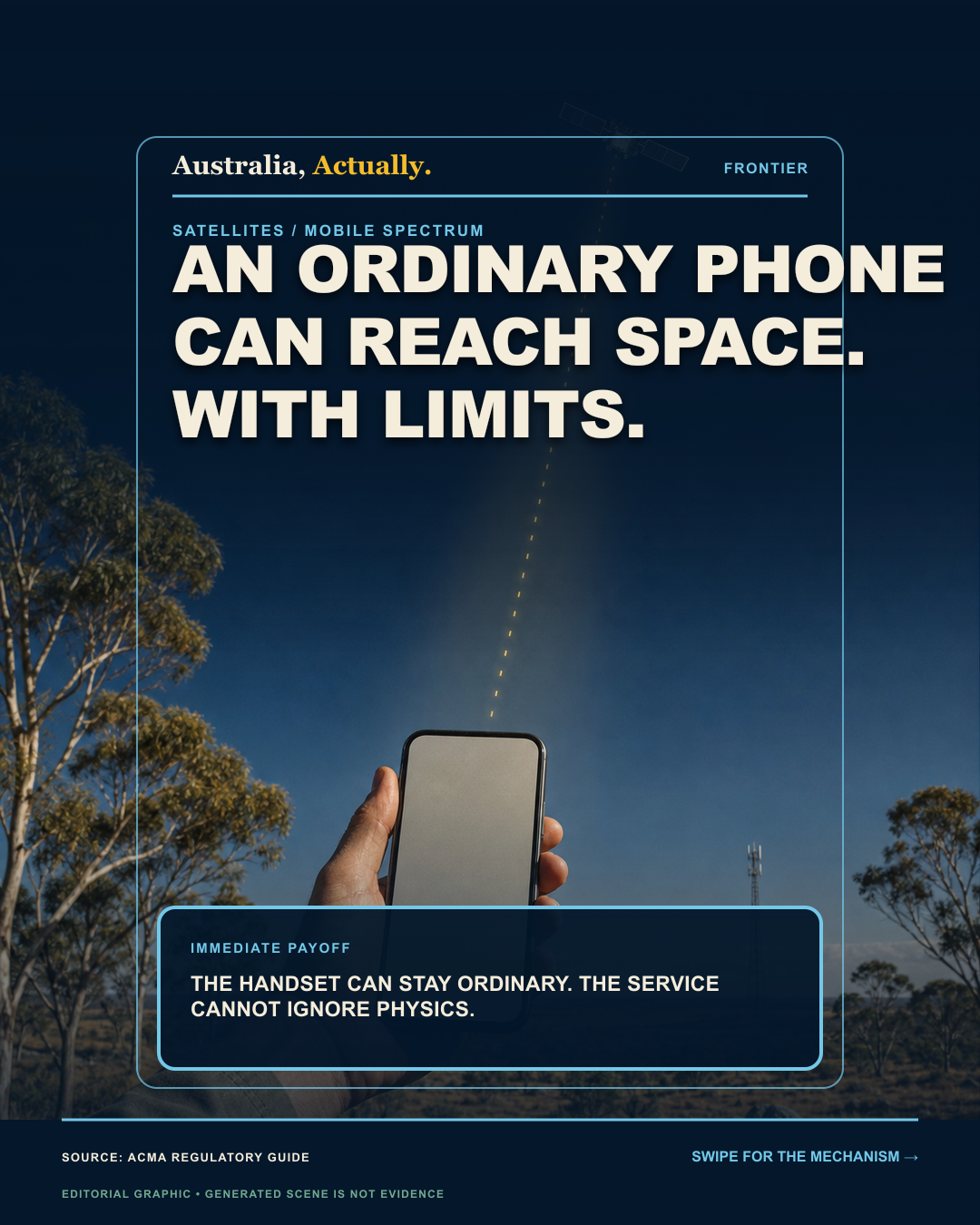
No dish is the surprising part. The limits are the important part: spectrum, network cooperation, sky view, interference, handset bands, service type and verified availability.
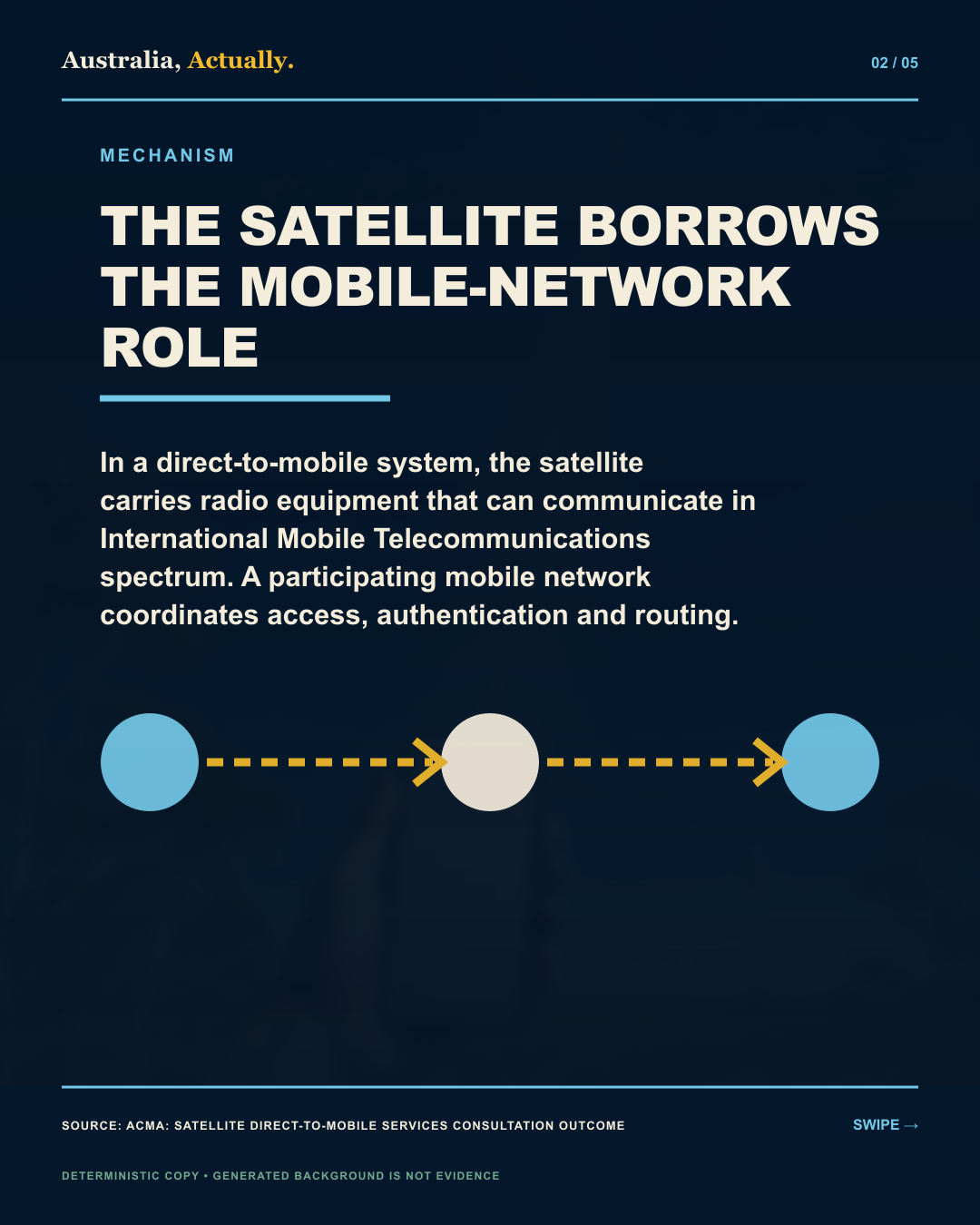
The satellite borrows the mobile-network role
In a direct-to-mobile system, the satellite carries radio equipment that can communicate in International Mobile Telecommunications spectrum. A participating mobile network coordinates access, authentication and routing. To the handset, the radio link can resemble an unusually distant cell. The satellite then connects the traffic through its broader network. The concept removes the dedicated satellite terminal, not the need for network infrastructure.
Distance makes the link constrained
A phone has a small antenna and limited transmit power. The signal must travel hundreds of kilometres and compete with noise, blockage and motion. A clear sky view helps, while buildings, terrain and foliage can weaken the path. Early or narrow services may prioritise messaging or low-data functions rather than matching terrestrial broadband. Capability depends on the operator's satellite design and the service it has tested.
Spectrum cannot be reused carelessly
The same mobile bands are valuable because ordinary handsets already support them. They are also used by terrestrial networks, so satellite transmissions need coordination to avoid harmful interference. ACMA's regulatory work considered how existing apparatus and spectrum licensing, international obligations and technical conditions apply when an IMT service operates from space. Authorisation is therefore part of the engineering, not an administrative afterthought.
Availability is provider specific
A regulatory framework does not make every handset, carrier, satellite and location work together immediately. Network participation, handset software, supported bands, roaming arrangements, service plans and satellite coverage all matter. Emergency communication claims need even more care because a feature can have geographic, device and message limits. The safe public statement is mechanism plus verified provider detail at a stated date.
The handset can remain ordinary because the satellite adapts to mobile spectrum; the physics does not become ordinary.
Direct-to-mobile can fill gaps where a terrestrial tower is absent or unavailable. Its strength is reach, not a promise to reproduce every tower service from orbit. A useful comparison asks what service is supported, on which device and network, with what sky view and on what date.
- ACMA: satellite direct-to-mobile services consultation outcome, Official Australian regulatory issues and consultation outcome for direct-to-mobile services.
- ACMA: regulatory guide for IMT satellite direct-to-mobile service, Official guide to licensing, spectrum and interference obligations.
ACMA consultation outcome and regulatory guide checked 3 August 2026. No provider availability, universal coverage, emergency guarantee or broadband-equivalent speed is claimed. Found a problem? See our correction process.