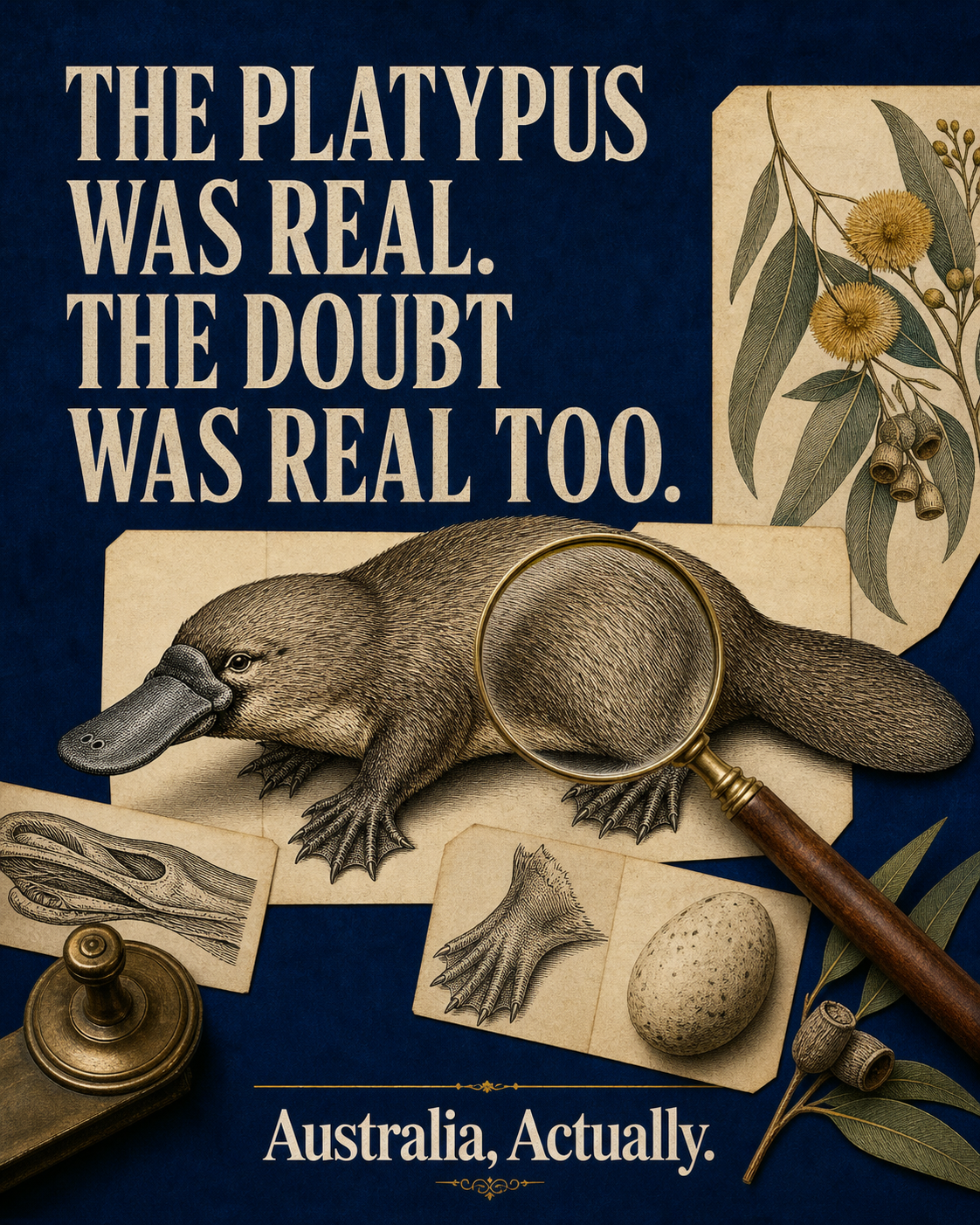
A bill that looked borrowed from a duck, fur, webbed feet, milk, eggs and venom. The platypus did not break nature's rules. It exposed how narrow the European rulebook had been.
What arrived in Europe
The first platypus specimens confronted European naturalists in 1798, according to the Australian Museum. They were not watching a living animal swim, feed or burrow. They were examining preserved material and an illustration sent from a distant colony.
That matters because fabricated creatures were a known problem in the collecting world. A prepared skin with an apparently duck like bill attached to a furry mammal could reasonably trigger a fraud check.
Suspicion was not the final verdict
The Natural History Museum records that some observers suspected a taxidermy construction. Yet George Shaw, keeper of the British Museum's natural history collection, accepted the animal as real. In 1799 he published the first scientific description and named it Platypus anatinus.
Shaw's original description is still available through the Biodiversity Heritage Library. It shows both wonder and caution. That combination is more accurate than the popular version in which science simply laughed at the animal.
Even its name became a puzzle
The name Platypus was already being used for a genus of wood boring beetles. Johann Friedrich Blumenbach published another description in 1803 using Ornithorhynchus paradoxus. The accepted scientific name eventually became Ornithorhynchus anatinus.
The modern common name stayed. The original scientific genus did not.
The deeper puzzle was classification
Acceptance did not make the platypus easy to classify. Preserved and incomplete specimens hid important anatomy. The animal had fur and produced milk, which placed it among mammals, yet it also laid eggs. Males carried venomous spurs.
Platypuses and echidnas are now grouped as monotremes, egg laying mammals that produce milk for their young. The animal was not a fake mixture. It was a living reminder that categories built from familiar European species did not contain all the forms evolution had produced.
The useful lesson is not that early naturalists were foolish. It is that extraordinary evidence can deserve both scrutiny and an open mind.
The conclusion
Mostly true. Some European observers did suspect that the first material was an artificial construction. But the evidence does not support the broader caricature that every scientist rejected it. George Shaw accepted the specimen and described it in print in 1799.
The hoax story survives because it is funny. The better story survives because it shows science doing two jobs at once: checking for deception and changing its categories when the specimen proves real.
- Australian Museum: Platypus Rug case, The 1798 specimens and contemporary disbelief.
- Museums Victoria: The platypus, a unique and vulnerable Australian, Indigenous Australians knew the animal long before European classification.
- Natural History Museum: The platypus puzzle, Shaw, the naming history and classification.
- Biodiversity Heritage Library: The Duck Billed Platypus, The public domain record of Shaw's 1799 publication.
Source links checked 1 August 2026. Found a problem? See our correction process.