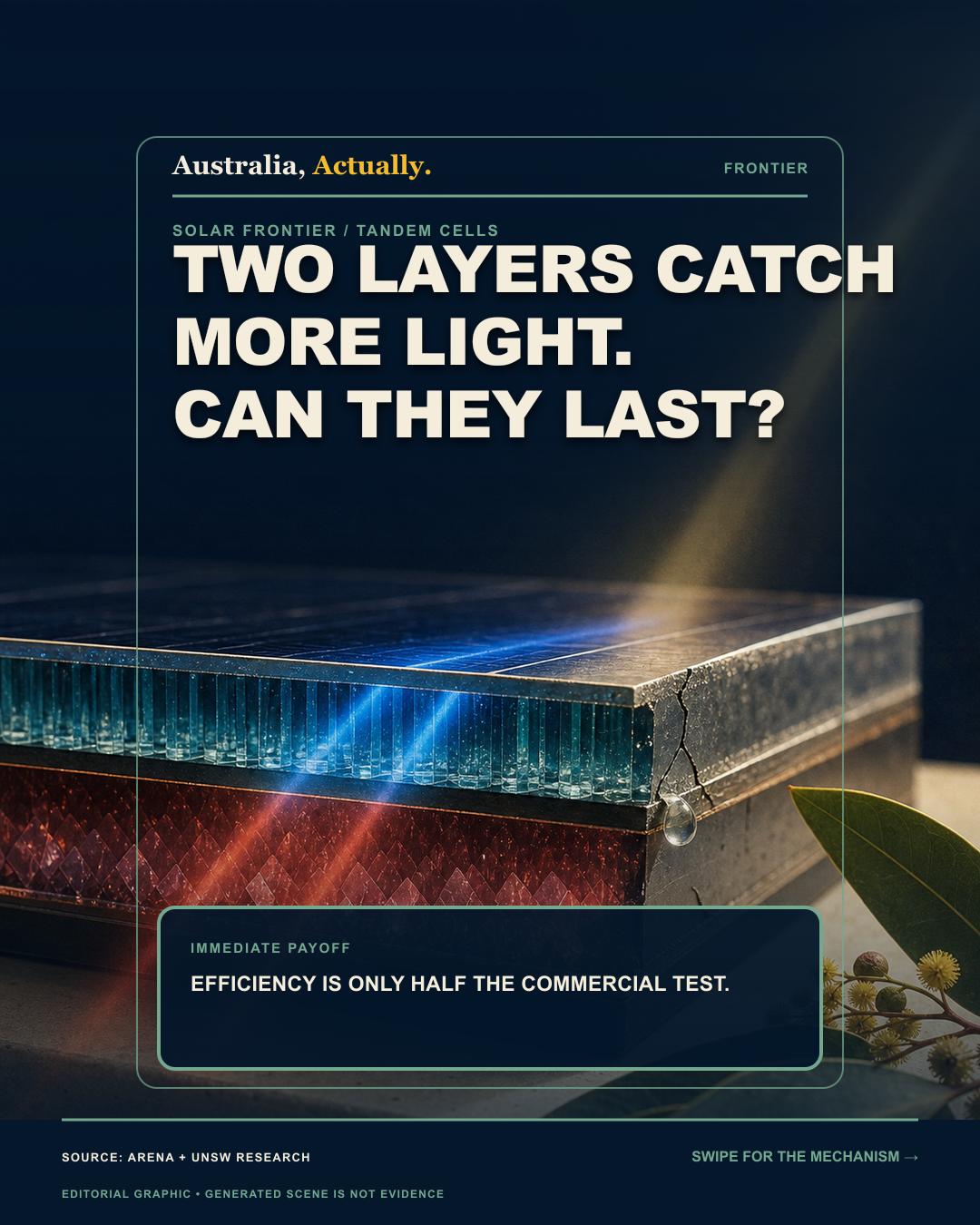
Tandem cells promise more output from a given area because two absorbers handle different parts of sunlight. The top layer must also survive heat, moisture, light and mass production.
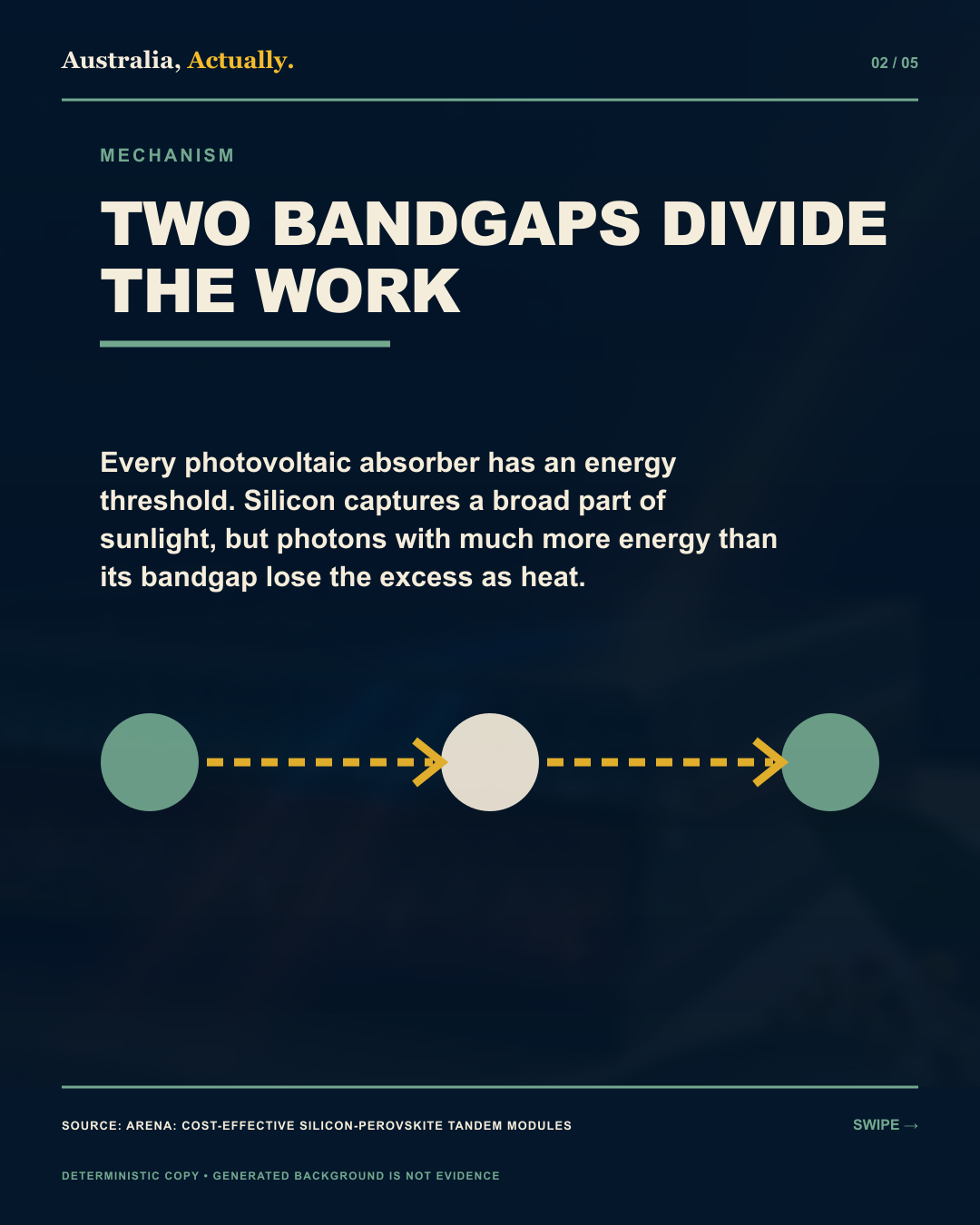
Two bandgaps divide the work
Every photovoltaic absorber has an energy threshold. Silicon captures a broad part of sunlight, but photons with much more energy than its bandgap lose the excess as heat. In a tandem, a wider-bandgap perovskite top cell converts more of the blue and higher-energy light. Lower-energy light passes to the silicon bottom cell. The pair can therefore use the spectrum more efficiently than either layer alone.
Integration creates new losses
A monolithic tandem deposits the perovskite device directly above the silicon cell and connects them as one package. The layers must be optically transparent where required, electrically compatible and current matched. Texturing that helps silicon capture light can make the upper film harder to coat uniformly. Interfaces, contacts and processing temperatures can improve one sub-cell while damaging the other.
Australian projects have moved beyond a tiny idea
ARENA-backed projects at ANU and partner institutions have demonstrated high-efficiency tandem cells on small and larger areas, developed textured silicon approaches and worked with industry partners. Current interim reporting says cells have passed important stability tests but further stability improvement is required for a commercial product. Project targets for modules describe the work programme, not guaranteed market performance.
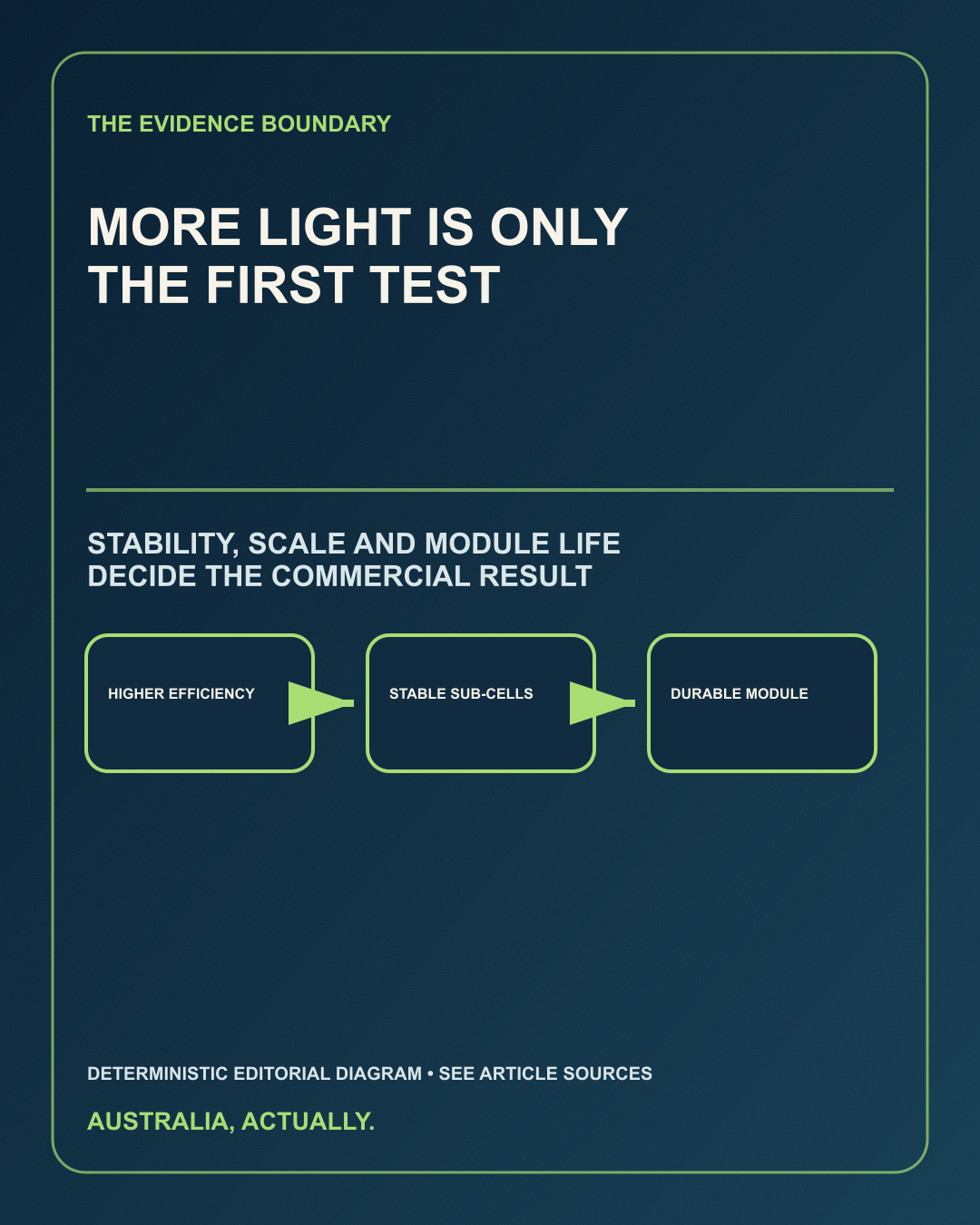
Durability decides whether efficiency is valuable
Perovskite materials and their contacts can be sensitive to moisture, heat, oxygen, prolonged illumination and electrical stress. Encapsulation can slow degradation, but it adds materials and manufacturing steps. A product must deliver stable power across a large module, survive outdoor cycling, be manufactured consistently and manage material recovery. Extra laboratory efficiency has little value if it disappears too quickly or destroys production yield.
The tandem catches more of the spectrum; commercialisation must catch every failure mode around it.
The frontier is no longer a choice between excitement and scepticism. The optical mechanism is sound and high-efficiency cells exist. The honest question is whether researchers and manufacturers can preserve that advantage across area, time, cost and production. Two layers can catch more light. Only a durable module can turn that into cheaper electricity.
- ARENA: cost-effective silicon-perovskite tandem modules, Current project scope for scalable tandem cells, industry integration and module development.
- ARENA: monolithic perovskite-silicon tandem cells, Completed Australian project history, efficiency rationale and commercialisation limits, updated April 2026.
- ANU interim report: cost-effective silicon-perovskite tandem, Primary interim evidence on texturing, cell area, stability tests and remaining commercial-stability work.
Primary source routes rechecked 2026-08-09; preserve project, demonstration and commercialisation boundaries. Recheck again immediately before authorised publication. Found a problem? See our correction process.