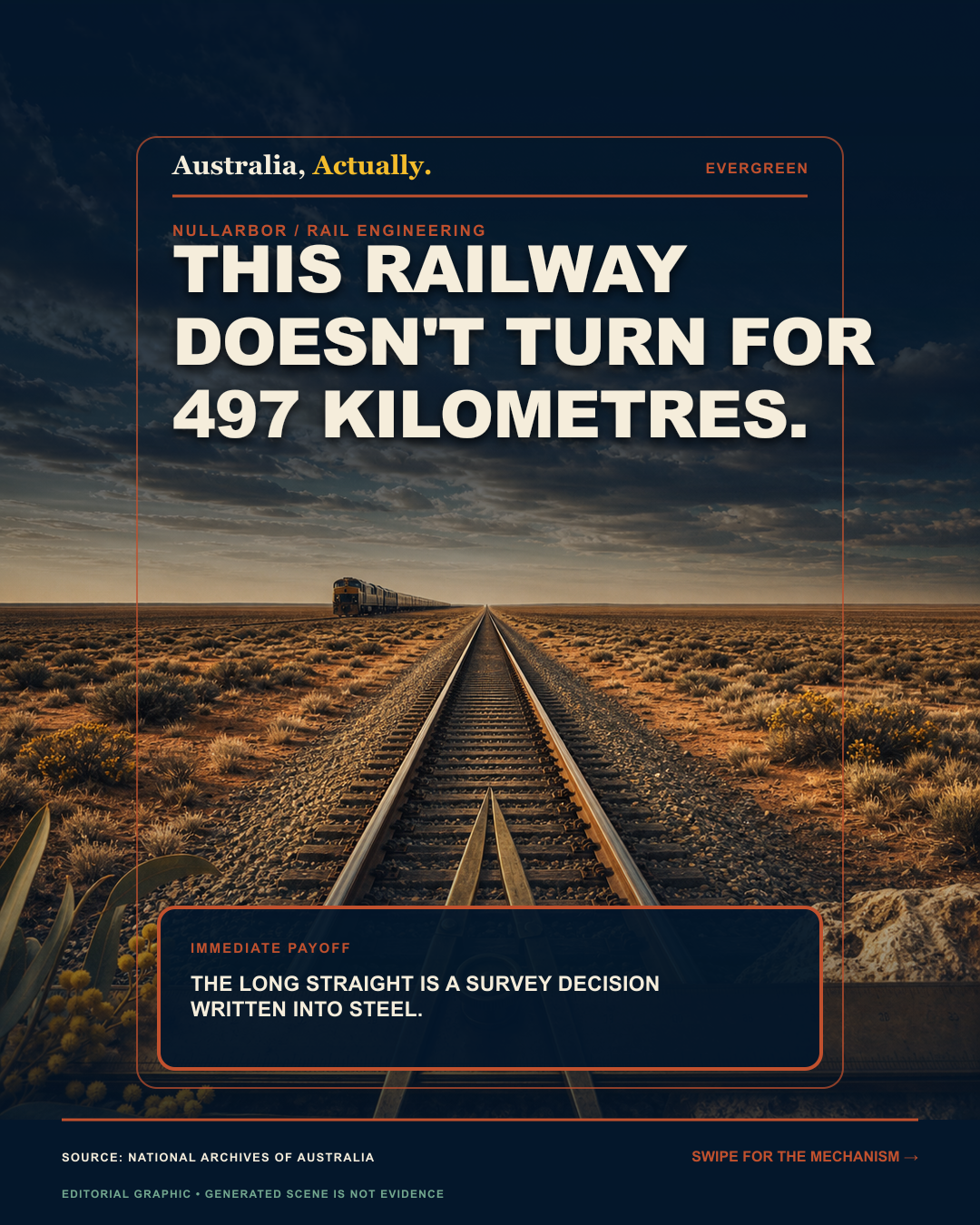
A train can travel for about 497 kilometres without a curve on the Trans-Australian Railway. The line is simple; the human and political work that put it there was not.
The straight is one section of a larger railway
The Trans-Australian Railway joined Port Augusta in South Australia with Kalgoorlie in Western Australia. Construction began in 1912 and the line opened in 1917. It provided a standard-gauge federal link across the continent at a time when state rail systems used different gauges. The famous straight section is therefore not the whole railway and not a line drawn from one coast to the other.
Terrain made a long alignment possible
Across part of the Nullarbor, surveyors encountered broad, low-relief country with few obstacles that required a change of direction. A straight alignment reduces curves and can simplify train movement, but it still has to respect grade, ground, drainage and the practical route between control points. The result was an approximately 497-kilometre section that the National Archives describes as believed to be the world's longest straight railway.
Straight did not mean easy
Construction camps had to move across a remote corridor. Water was scarce, materials and food travelled long distances, and workers lived with heat, isolation and difficult supply. The geometry can make the landscape look empty in a photograph, but the archival record is full of labour, machines, camps and logistics. The engineering achievement includes supporting the workforce that made the straight line physical.
The railway was also a federation project
Western Australia's decision to join the federation was tied to expectations of a transcontinental railway. The Commonwealth survey and construction programme turned that political connection into infrastructure. The line carried passengers, mail and freight, and it improved east-west movement during later national emergencies. Its straightest segment is memorable because one piece of geometry makes a much larger national project visible.
The Nullarbor straight is simple geometry produced by complicated nation building.
The claim survives scrutiny when its boundaries remain attached. It is an approximately 497-kilometre straight section, not a perfectly verified global record with no uncertainty and not proof that the route required no engineering. The steel looks inevitable only after the surveying, labour and political decisions disappear from view.
- National Archives of Australia: Trans-Australian Railway workers camp, Official archival description of construction, camps and the approximately 497-kilometre straight section.
- National Museum of Australia: Trans-Australian Railway, National history of the federation promise, construction and opening of the line.
National Archives and National Museum histories were checked 3 August 2026; both source routes were re-opened without a material change on 5 August 2026. The visual is an editorial horizon, not a survey map or measurement. Found a problem? See our correction process.