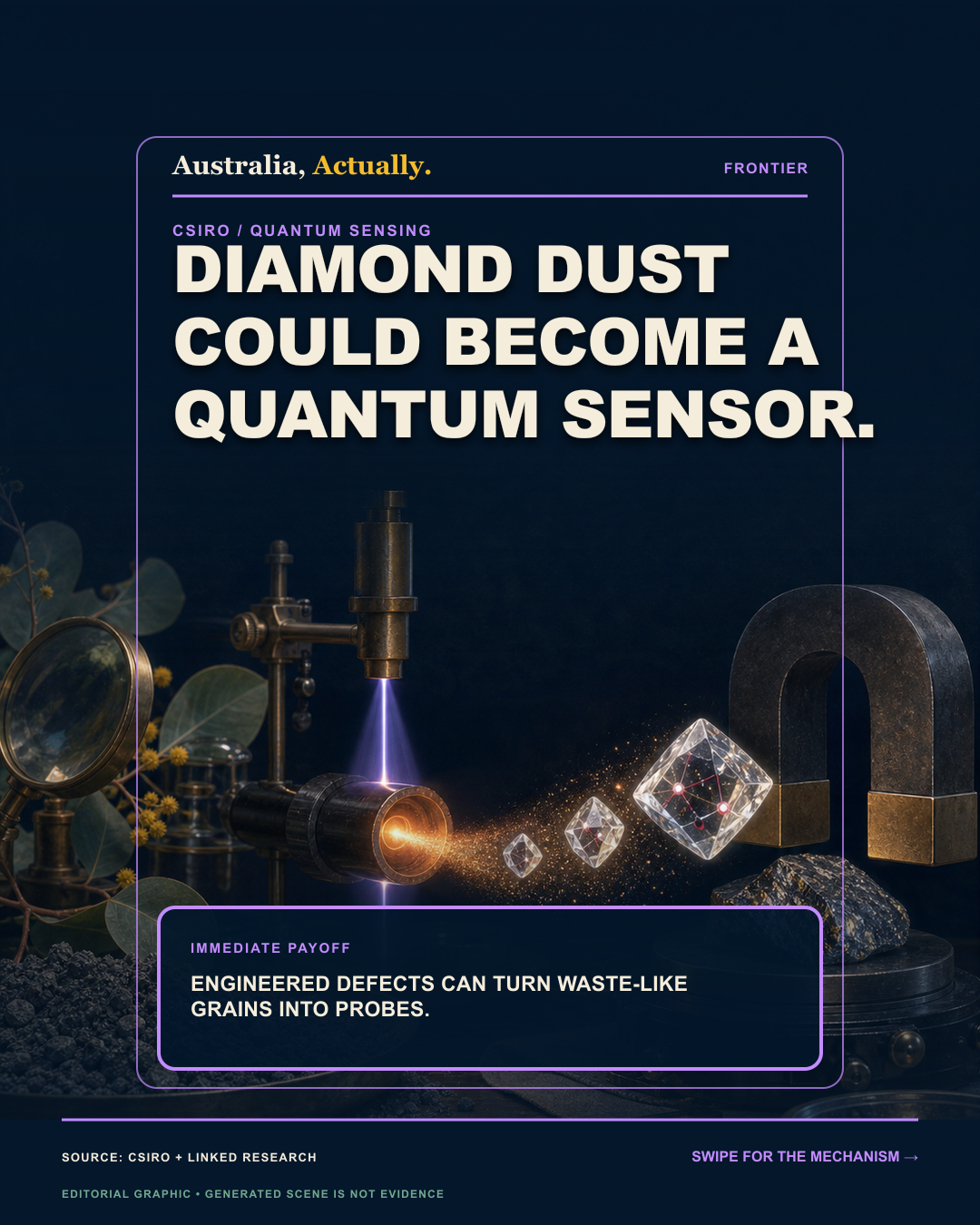
A flaw can be the useful part of a diamond. Engineered nitrogen-vacancy centres respond to tiny changes in their surroundings and can be read with light.
The defect is the sensor
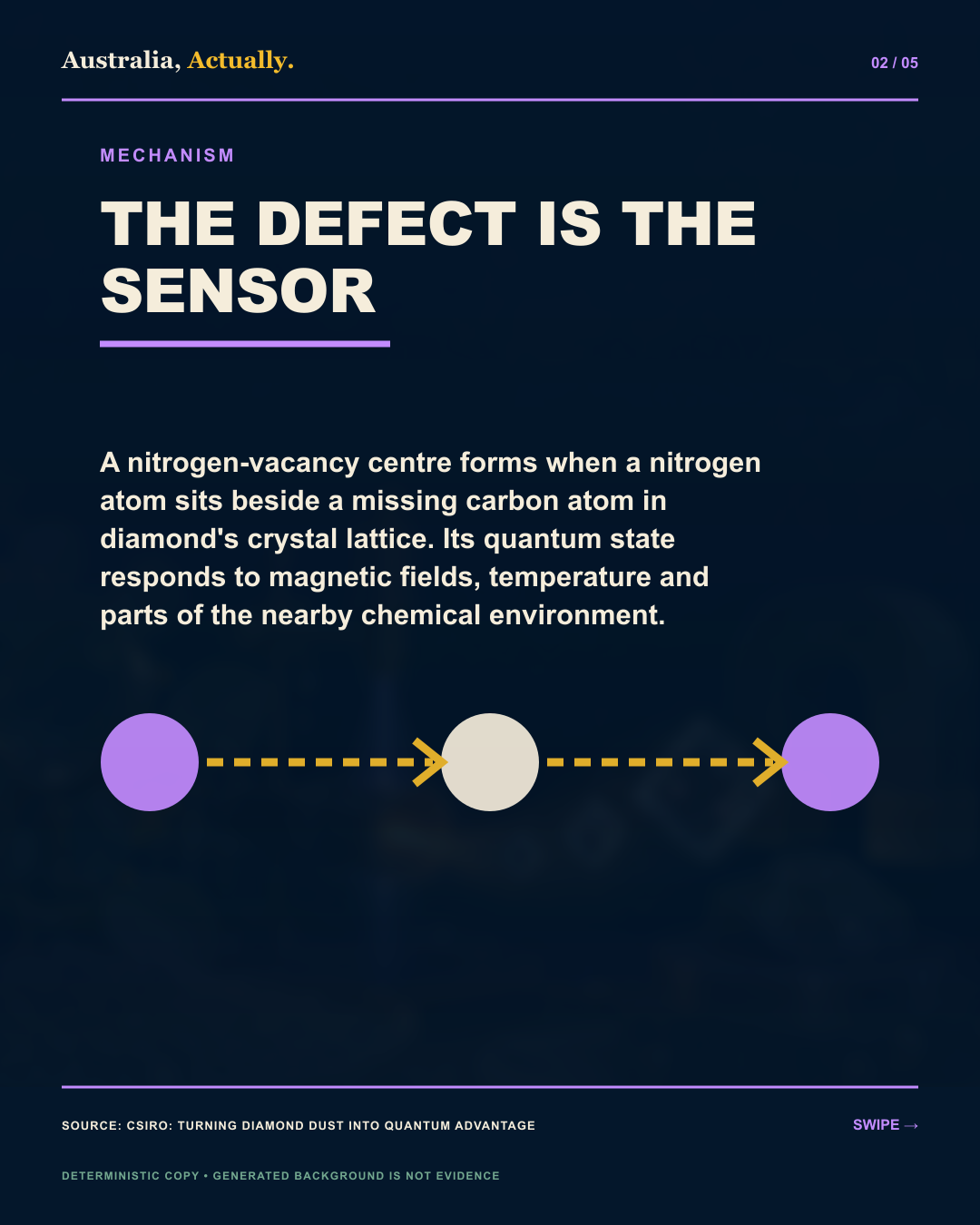
A nitrogen-vacancy centre forms when a nitrogen atom sits beside a missing carbon atom in diamond's crystal lattice. Its quantum state responds to magnetic fields, temperature and parts of the nearby chemical environment. Laser light and the emitted fluorescence allow researchers to read that response. The surrounding diamond protects the centre, and very small diamonds can bring it close to the material or molecule being studied.
Industrial particles change the cost question
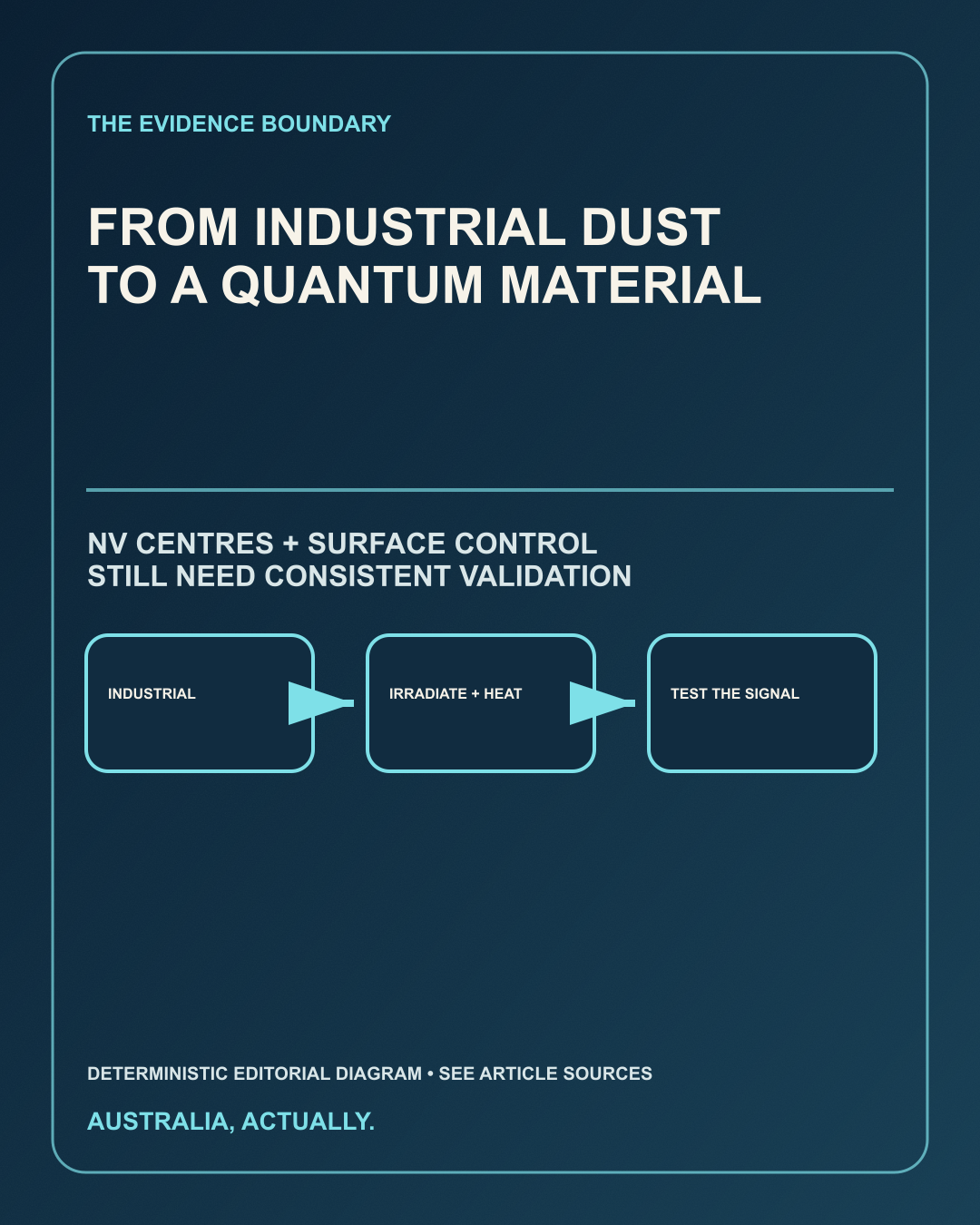
Many laboratory systems depend on carefully made single-crystal diamond, which can be scarce and expensive. The CSIRO-led work starts with cheap industrial-grade diamond dust and develops manufacturing routes to nanodiamonds with useful centres. Irradiation, heat treatment, sorting and surface processing can influence how many defects form and whether their signals remain stable enough to measure.
Small sensors can work near small targets
A nanodiamond can be placed close to a nanoscale magnetic or chemical source while operating at room temperature. That geometry is why researchers discuss future environmental monitoring, materials analysis, navigation and biomarker work. The word future is essential. A sensing mechanism demonstrated in controlled research is not automatically a field instrument, diagnostic result or regulatory-approved medical device.
Manufacturing consistency is the frontier
Turning a few promising particles into a reliable supply requires control over size, defect density, charge state and surface chemistry. Brightness alone is not enough if particles vary unpredictably or interact badly with the sample. The Australia-Japan collaboration matters because it joins material processing and surface chemistry with specialised quantum-beam facilities and characterisation that are not all available in one laboratory.
The quantum advantage is not perfect diamond. It is a useful imperfection made reproducibly.
The strong claim is therefore bounded. Diamond dust is a promising feedstock for lower-cost quantum sensing materials, and nitrogen-vacancy centres provide the sensing mechanism. The open work sits between those statements and a dependable product: manufacture the right defects, control the particles and prove performance in each intended use.
- CSIRO: turning diamond dust into quantum advantage, June 2026 project explanation, partners, manufacturing aim, NV-centre mechanism and potential applications.
- Australian National University repository: quantum diamond research, Research context for nitrogen-vacancy diamond sensing and its measurement principles.
Primary source routes rechecked 2026-08-09; preserve project, demonstration and commercialisation boundaries. Recheck again immediately before authorised publication. Found a problem? See our correction process.