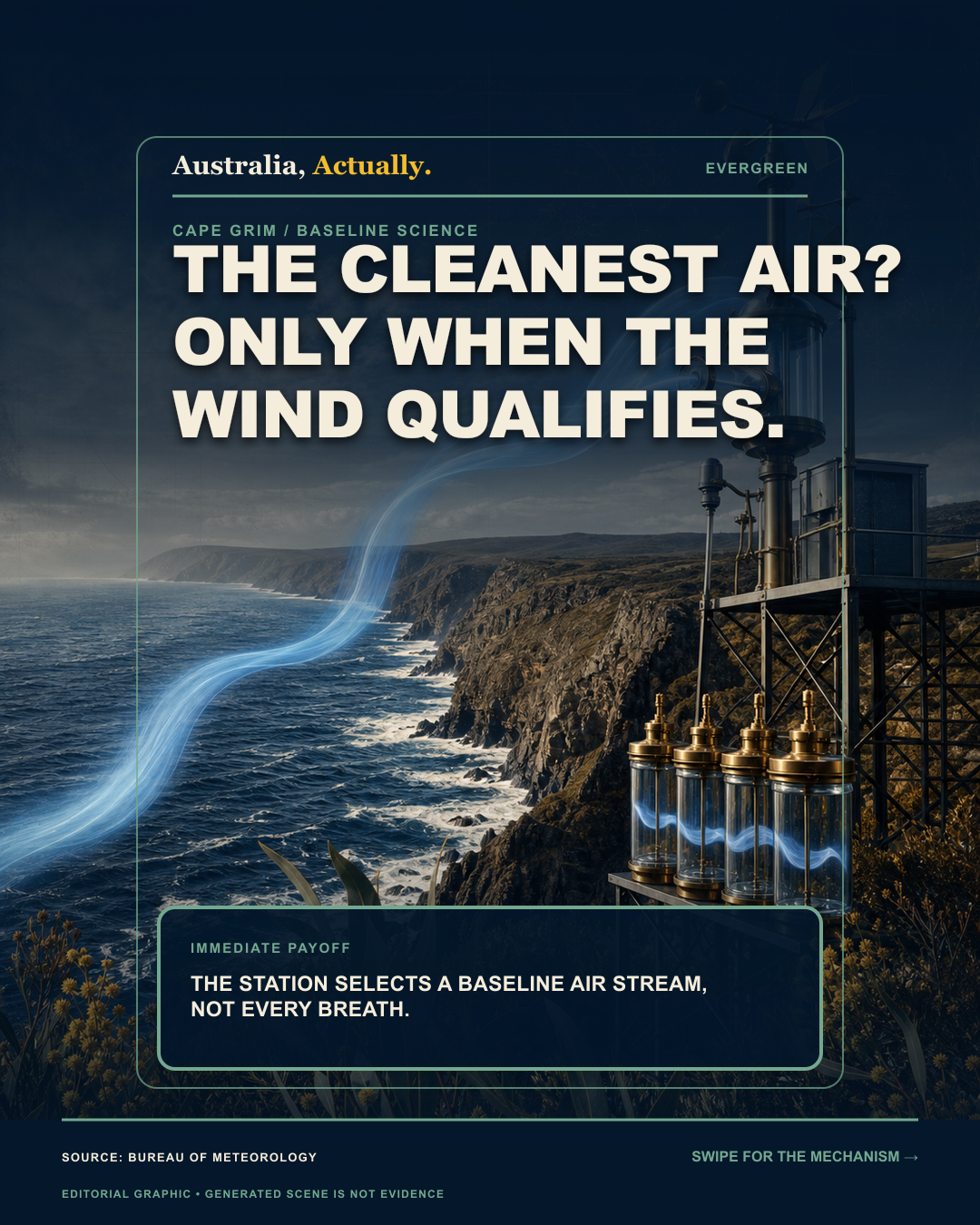
Kennaook/Cape Grim is valuable because scientists can separate baseline air from air recently influenced by land. The superlative only makes sense with that sampling boundary attached.
The clean air is a selected air mass
Kennaook/Cape Grim sits on Tasmania's northwest coast. When winds come from the west and southwest, the arriving air has travelled over the Southern Ocean and has had limited recent contact with populated land. The Bureau of Meteorology identifies those conditions as the baseline sector. Measurements from other wind directions can still be scientifically useful, but they answer a different question about regional or continental influence.
Baseline does not mean untouched by the planet
A baseline sample is not air from outside human influence. Long-lived greenhouse gases and other globally mixed substances travel through the atmosphere. The baseline is a reference with minimal recent local contamination, allowing researchers to observe the background state more clearly. That distinction is why rising carbon dioxide at a remote station can reveal global accumulation rather than contradict the description of very clean local air.
Fifty years makes change visible
The Cape Grim Baseline Air Pollution Station began continuous work in 1976 and is operated by the Bureau with CSIRO. A consistent location, carefully characterised winds, calibrated instruments and repeated methods create a long record. Scientists use it to track greenhouse gases, ozone-depleting substances, aerosols, reactive gases and other components. The reward is not a scenic superlative. It is a dependable comparison through time.
Archived air lets the past be measured again
The programme also preserves samples in the Cape Grim Air Archive. As instruments improve or new compounds become important, stored air can be analysed with techniques that did not exist when the sample was collected. The archive therefore turns the atmosphere into a physical time series. It can help researchers reconstruct when a gas began changing and compare that history with policy, industry and natural processes.
Cape Grim's advantage is not a permanent clean-air crown. It is a well-defined baseline carried by the right wind.
The accurate headline keeps the condition attached. Cape Grim samples some of the world's cleanest air under baseline winds, and that air still contains the global atmosphere scientists need to measure. Wind selection, disciplined instruments and a half-century record are what turn the site into evidence.
- Bureau of Meteorology: Kennaook/Cape Grim Baseline Air Pollution Station, Official station description, baseline sector, measurements and operating partnership.
- Bureau of Meteorology: fifty years measuring the world's cleanest air, Dated 2026 history of the programme, its long record and the Cape Grim Air Archive.
Bureau of Meteorology station and 50-year material checked 3 August 2026. The clean-air description is conditional on baseline-sector sampling. Found a problem? See our correction process.