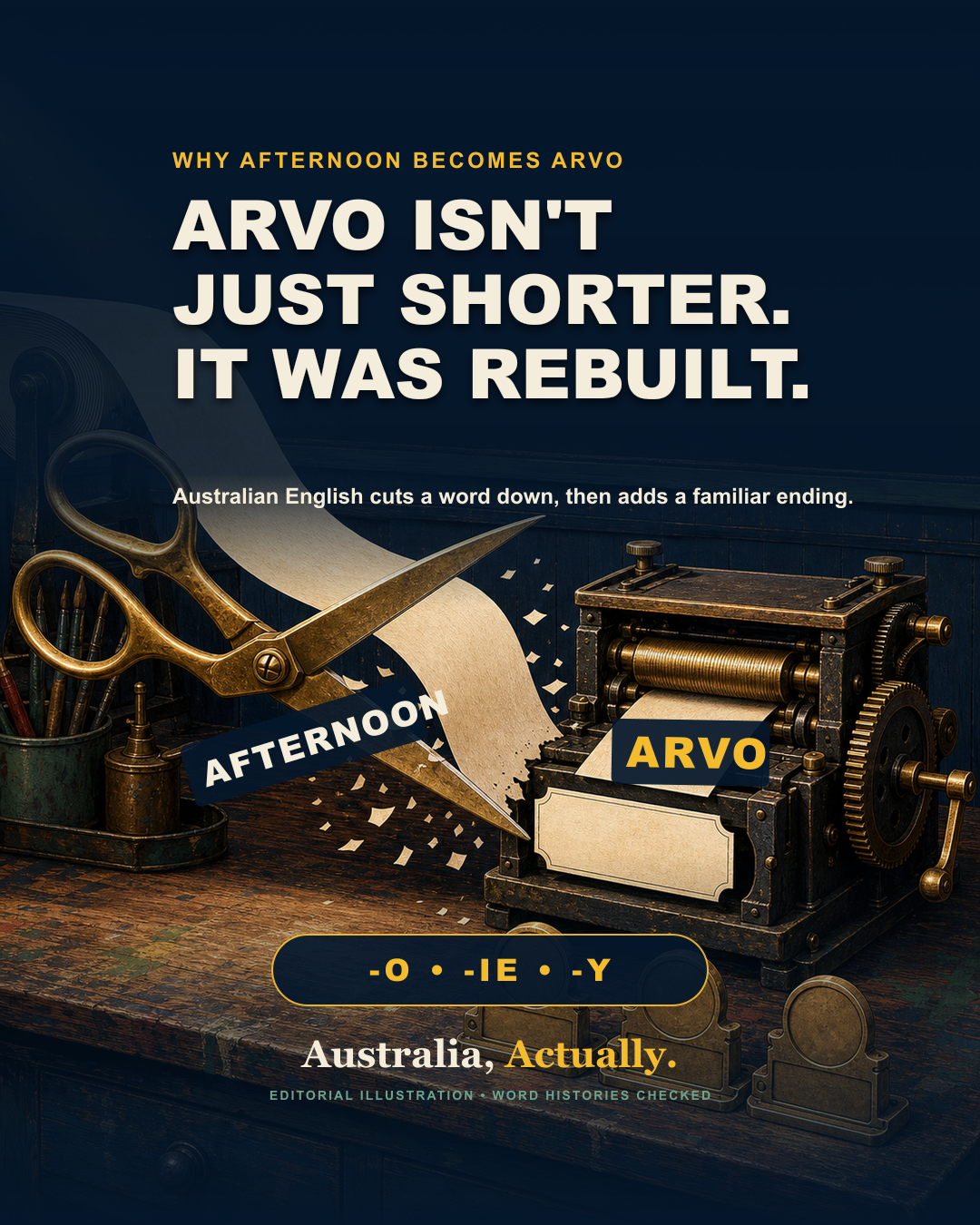
The recurring Australian move is truncation plus a familiar informal ending. The interesting part is not just the slang, but the repeatable word-building system and the boundaries around it.
It is word formation, not random abbreviation
The Australian National Dictionary Centre describes arvo as a special feature of Australian English: an abbreviated word with o added. Its earliest evidence is from the 1920s, and the centre records the form as current. The process is easier to see than its technical name, hypocoristic. Keep a recognisable piece of the original, reshape it, and give the result an informal ending.
The same move works across very different bases. Ambo comes from ambulance officer. Nasho came from national service or a national serviceman. Troppo formed from tropic and appeared in the expression go troppo among Australian troops in the Pacific during the Second World War. The spellings vary, but the recurring operation is truncation plus a familiar ending.
A ten-word trail
The dated trail begins with Aussie in 1915 and mozzie in a 1916 citation. Arvo appears in 1920s evidence. Ute, a useful no-suffix control, is recorded from 1943. Troppo has a 1945 citation, while nasho and sickie appear in 1953. Uey is recorded from 1973, ambo from the 1980s with a 1986 citation, and firie from the 1980s with a later 1998 citation.
Ute matters because it shows the boundary. Australian English also shortens words without adding o, ie or y. The suffix is a recurring tool, not a mechanical law. Earliest dictionary evidence is also a current research record rather than a claim that nobody used the form earlier. An older citation can move the recorded date.
What a 115-person study found
In a 2011 study, 115 adult speakers of Australian English aged 17 to 84 had ten minutes to generate as many hypocoristics as they could. The researchers analysed the collection by linguistic class rather than treating it as random slang. Speakers produced many examples that fell into recurring patterns.
That task does not estimate how often every Australian uses every form. It was a timed generation exercise, not a nationally representative usage survey. Its value is narrower and still useful: the participants could generate a large set, and the forms showed repeatable word-building structures.
Is the pattern uniquely Australian?
No. Shortening and affectionate or informal endings occur in other English varieties. A comparative study of New Zealand and Australian English found broadly similar systems in both countries. In the authors' data, ie was the most common hypocoristic ending in each. The clearer difference was greater Australian use of o among common nouns, geographical names and some occupational domains, including fishing.
That makes o a useful Australian signal, not an Australian ownership stamp. The dictionary centre gives a simple warning by identifying forms such as aggro and cheapo as non-Australian formations. A word's shape alone cannot establish where it began.
What the forms can do socially
Informal vocabulary can carry more than a dictionary meaning. Two scripted-interaction studies published in 2016 tested Australian hypocoristics such as uggie, uni and derro. In the reported conditions, their use increased participants' perceived common ground with an in-group speaker, but not with an out-group speaker.
That is evidence that these forms can help mark familiarity and group identity. It is not evidence that every speaker uses them, that every listener welcomes them, or that adopting a few terms automatically creates belonging. Register matters. A form can sound ordinary between friends, too casual in a formal setting, dated to a younger speaker or unfamiliar outside a particular occupation or region.
Australian English often shortens and rebuilds. The ending is a tendency, not a passport stamp.
The conclusion
Australian English does more than remove syllables. It repeatedly turns a shortened base into a new informal word, often with o, ie or y. That is why afternoon becomes arvo rather than merely aft. Keep the limits attached and the explanation becomes more interesting: the process is shared across English varieties, the Australian preference for o is a tendency rather than a rule, and real usage changes by word, speaker, setting and time.
- Australian National Dictionary Centre: meanings and origins of Australian words and idioms, Curated histories and earliest recorded evidence for arvo and other Australian terms. Earliest citations can change when older evidence is found.
- Kidd, Kemp and Quinn: a quantitative look at Australian hypocoristics, The 2011 timed generation study with 115 adult Australian English speakers.
- Bardsley and Simpson: Hypocoristics in New Zealand and Australian English, Comparative evidence showing related systems and the bounded Australian preference for o in several domains.
- Kidd, Kemp, Kashima and Quinn: social effects of colloquial Australian English, Scripted-interaction studies about perceived common ground, not a universal measure of belonging or usage.
Sources and comparative-paper routes checked 3 August 2026. This article describes documented language patterns and examples, not one uniform way that all Australians speak. Found a problem? See our correction process.