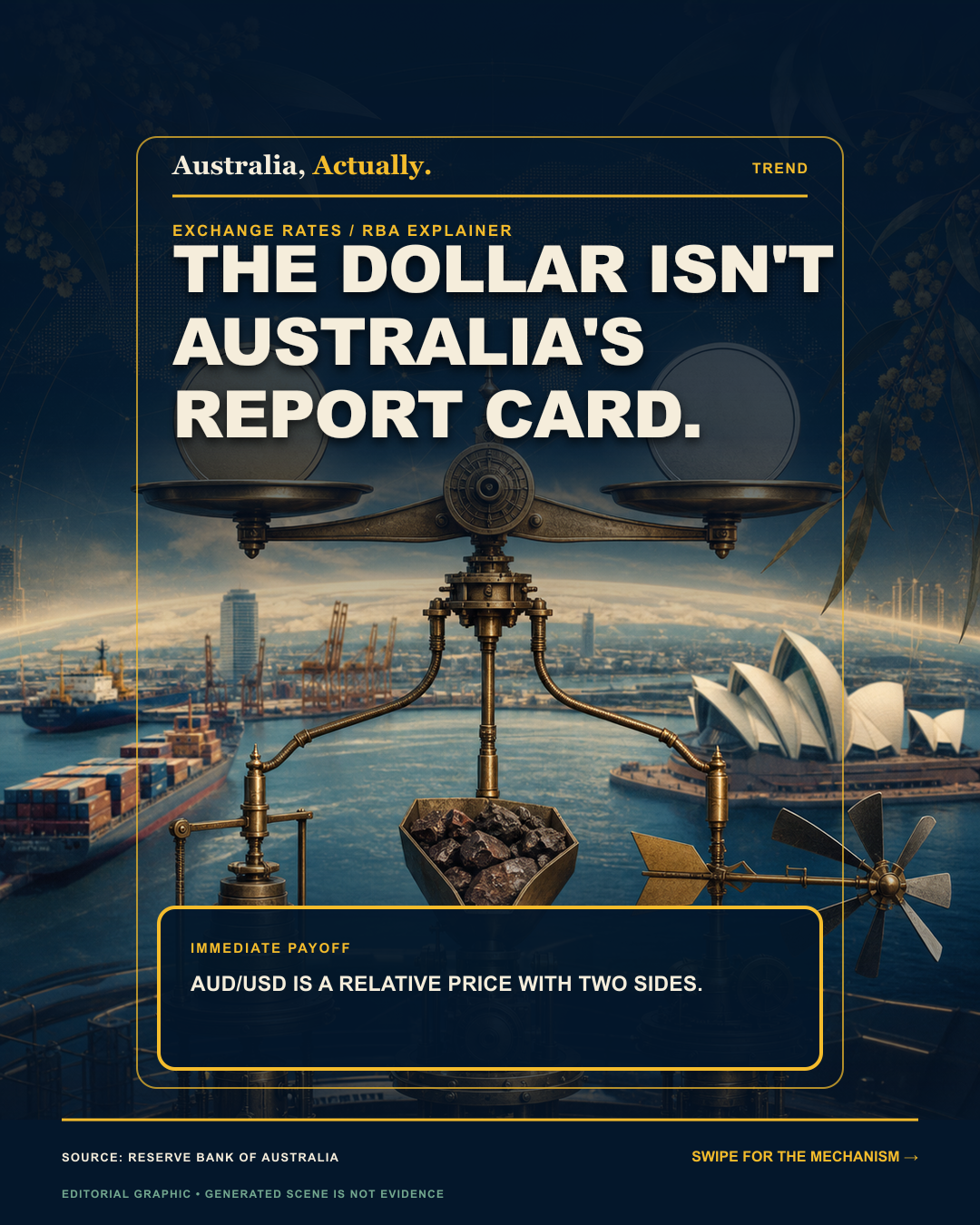
A bilateral exchange rate is a balance, not a score. Reading it properly means asking what changed on both sides and whether another currency measure tells a different story.
Every exchange rate has two sides
If AUD/USD rises, one Australian dollar buys more US dollars. That can happen because investors want more Australian-dollar assets, because they want fewer US-dollar assets, or because the relative change favours Australia. The same outward movement can therefore be produced by different underlying stories. Calling it a simple vote of confidence in Australia discards half of the equation before the analysis begins.
Interest and commodities are important, not exclusive
The Reserve Bank identifies interest-rate differences, commodity prices and the terms of trade as important drivers over different periods. Expected returns can affect demand for Australian-dollar assets. Higher prices for major Australian exports can increase income and demand associated with the currency. These relationships are not switches. Markets respond to expectations, and other developments can offset or overwhelm them.
Global risk can strengthen the other side
The US dollar plays a large role in global finance and is often sought during periods of market stress. AUD/USD can fall because global investors move toward US-dollar liquidity even when the immediate Australian data have not collapsed. Longer-run influences can include relative productivity, inflation and trade patterns. A single day's movement cannot identify which driver dominated without additional evidence.
Use more than one currency comparison
AUD/USD is useful for transactions and comparisons linked to the United States. The Reserve Bank's trade-weighted index compares the Australian dollar with a basket of currencies weighted by Australia's trade. The two measures can move differently because trading partners' currencies do not all behave like the US dollar. Looking at both reduces the risk of treating one bilateral relationship as the whole external value of the currency.
A currency pair is a relative price, not a medal table for two economies.
The disciplined reading is a set of questions rather than a verdict. Which side of the pair changed? Which expectations moved? Did commodity prices or global risk shift? Does the trade-weighted index tell the same story? Those questions turn a flashing market number into an explanation and keep the article away from unsupported forecasts.
- Reserve Bank of Australia: exchange rates overview, Official definitions, current-rate context and the trade-weighted index.
- Reserve Bank of Australia: drivers of the Australian dollar exchange rate, Official explainer on interest rates, commodity prices, terms of trade and other drivers.
Reserve Bank explainers checked 3 August 2026. No live rate, forecast, investment recommendation or currency-trading advice is provided. Found a problem? See our correction process.